Page 24 - PERKASA_JanMar2017(1)
P. 24
24
Other
Timber
products
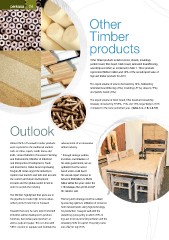
Other timber products included veneer, dowels, mouldings,
particle board, fibre board, block board, laminated board/flooring,
woodchip and others as mentioned in Table 1. These products
represented RM822 million and 14% of the overall export value of
logs and timber products for 2016.
The export volume of veneer decreased by 14%, followed by
laminated board/flooring (-6%), moulding (-51%), dowel (-23%)
and particle board (-8%).
The export volume of block board, fibre board and woodchip
however, increased by 3158%, 15% and 15% respectively in 2016
compared to the same period last year. (Table 5, 6, 7, 8, 9 & 10)
Outlook
Almost 99% of Sarawak’s timber products advancement of an innovative
were exported to the traditional markets timber industry.
such as China, Japan, South Korea and
India. Second Minister of Resource Planning “Through strategic policies,
and Environment, Minister of Industrial incentives and initiatives of
and Entrepreneur Development, Trade the state government, we are
and Investment, Datuk Amar Haji Awang optimistic that the wood-
Tengah Ali Hasan urged the industry to based sector could boost
explore new markets and take into account the annual export revenue to
the current and future development between RM8 billion to RM10
scenario and the global market trends in billion within five years under the
order to sustain the industry. 11th Malaysia Plan (2016-2020)”
the minister said.
The Minister highlighted that plans are in
the pipeline to create high income value- This long term strategy could be realised
added product industries in Sarawak. by ensuring optimum utilisation of resources
from natural forests using high technology
Towards that end, he said, export oriented for production. It augurs well with the
industries will be developed to produce revised log quota policy in which 70% of
furniture, decorative panel products as logs are for local processing activities and the
well as pulp and paper. This is in line with remaining 30% for export. The policy came
STIDC mission to regulate and facilitate the into effect in July 2016.
Other
Timber
products
Other timber products included veneer, dowels, mouldings,
particle board, fibre board, block board, laminated board/flooring,
woodchip and others as mentioned in Table 1. These products
represented RM822 million and 14% of the overall export value of
logs and timber products for 2016.
The export volume of veneer decreased by 14%, followed by
laminated board/flooring (-6%), moulding (-51%), dowel (-23%)
and particle board (-8%).
The export volume of block board, fibre board and woodchip
however, increased by 3158%, 15% and 15% respectively in 2016
compared to the same period last year. (Table 5, 6, 7, 8, 9 & 10)
Outlook
Almost 99% of Sarawak’s timber products advancement of an innovative
were exported to the traditional markets timber industry.
such as China, Japan, South Korea and
India. Second Minister of Resource Planning “Through strategic policies,
and Environment, Minister of Industrial incentives and initiatives of
and Entrepreneur Development, Trade the state government, we are
and Investment, Datuk Amar Haji Awang optimistic that the wood-
Tengah Ali Hasan urged the industry to based sector could boost
explore new markets and take into account the annual export revenue to
the current and future development between RM8 billion to RM10
scenario and the global market trends in billion within five years under the
order to sustain the industry. 11th Malaysia Plan (2016-2020)”
the minister said.
The Minister highlighted that plans are in
the pipeline to create high income value- This long term strategy could be realised
added product industries in Sarawak. by ensuring optimum utilisation of resources
from natural forests using high technology
Towards that end, he said, export oriented for production. It augurs well with the
industries will be developed to produce revised log quota policy in which 70% of
furniture, decorative panel products as logs are for local processing activities and the
well as pulp and paper. This is in line with remaining 30% for export. The policy came
STIDC mission to regulate and facilitate the into effect in July 2016.